
Understanding Gray Wolf DNA, Phenotype, and Breed Preservation Through Embark Testing
When people see “gray wolf” in a dog’s DNA report, it can spark alarm, confusion — and a flurry of social media claims. For those of us working to preserve the Native American Indian Dog (NAID), it’s a common and frustrating misunderstanding. Are NAIDs secretly wolfdogs? Are they legal? Are they dangerous?
Let’s set the record straight — using real science and a direct conversation with Zach Lounsberry, lead geneticist at Embark Veterinary, who specializes in North American wolf-like canid genomics.
Why Does “Gray Wolf” Show Up in NAID DNA?
Many NAIDs tested through Embark show a percentage of gray wolf ancestry. This is because, as Zach explains:
“If gray wolf was involved in the formation of the breed group, then that signal will persist for many generations, assuming the wolf alleles are not selected against.”
In plain terms: a distant ancestor may have had wolf DNA, and it stuck around. That’s not the same thing as recent hybridization — in fact, it’s common in many breeds with northern or primitive roots. This lingering wolf signal doesn’t mean your dog is part-wolf.
But Doesn’t Embark Label Any Wolf DNA as Wolfdog?
This is where nuance is crucial. Zach explained that:
“We tend to treat dogs with any amount of gray wolf ancestry as wolfdogs… because we don’t currently use their genomic positions in our reporting, the safer bet is to treat any dog with gray wolf ancestry as a wolfdog.”
That’s a precautionary stance, not a factual claim about every individual dog. Embark isn’t saying your NAID is a wolfdog — they’re saying their system defaults to caution because they don’t yet evaluate where in the genome that wolf signal appears.
Zach elaborates:
“A dog can be 50% wolf and not look or act like one, where a dog with 5% could be very wolfy in appearance or behavior… The impact on phenotype is complex and unpredictable.”
So what does this mean for NAID owners? It means DNA results need context. A gray wolf percentage alone doesn’t define your dog’s behavior, legal status, or essence.
Why NAIDs Don’t Have a Genetic “Breed Signature” — Yet
One of the reasons Embark can’t identify NAIDs as a distinct breed is that, genetically, NAIDs are not yet standardized. As Zach put it:
“Thus far, NAIDs do not have a reliable signal of unique genetic ancestry.”
This is because:
- NAIDs were formed from multiple older breeds and landrace types
- There’s been widespread outcrossing and inconsistent recordkeeping over the years
- When submitting samples to Embark, most NAID owners enter “Mixed Breed,” making it much harder to identify which dogs tested are actually NAIDs
This lack of consistent labeling and standardization means Embark doesn’t yet have enough clean data to detect a unique genetic pattern across all NAIDs — but that doesn’t mean the dogs lack consistency in other ways.
Genetics vs. Phenotype: Why What You See Matters
While Embark focuses on shared stretches of DNA (haplotypes), Zach also confirmed the importance of traditional breed formation through selection:
“Traditional breeding methods of selecting for traits or behaviors… can create dogs that are phenotypically consistent with a breed while dogs in that line may not have reliably detectable ancestry from the breeds those traits or behaviors come from.”
Translation: You can have dogs that act and look like a specific breed, even if the DNA test can’t name it. This is especially true in emerging or primitive breeds like the NAID.
That’s why the NAID Preservation Project focuses on preserving phenotype — the physical and behavioral traits — rather than chasing a paper pedigree or a DNA label.
What Does “F-Generation” Mean in NAID Breeding?
At Corn Moon Medicine Dogs and throughout the NAID Preservation Project, you’ll often see us refer to an “F-gen” — like F1, F2, all the way up to F7. But what does that mean?
The “F” stands for “filial,” which simply means generation. This is a system used in both livestock and canid breeding programs to track how many generations a dog is removed from its founding cross or outcross ancestor.
In our program, we use filial generation (or “F-gen”) to track how far removed a dog is from its original foundation crosses. For example, an F1 is a first-generation dog whose parents come from two distinct lines or breeds; F2 results from two F1s being bred together, and this pattern continues as the generational number increases. By the time a dog reaches F7, the lineage has undergone multiple cycles of recombination, and the traits we’re selecting for — including temperament, health, and appearance — begin to stabilize into a consistent and recognizable standard. That said, within the NAIDPP, we consider dogs at F4 and higher to be “purebred” within our registry. This is because, by F4, the influence of the original outcrosses is reduced to a very small percentage, and the traits we associate with the traditional Native American Indian Dog phenotype become reliably present.
It’s important to understand that we do not define a dog’s value or legitimacy by F-gen alone. Filial generation is just one tool among many we use — alongside genetic diversity (COI and IR), health testing, temperament evaluation, and phenotype consistency — to build a stable, sustainable population. We intentionally avoid the narrow thinking that focuses solely on achieving a high F-gen or chasing arbitrary blood percentages. Our goal is not only to restore this ancient landrace-type dog but to do so responsibly, with respect for the complexity of genetic preservation and the integrity of the breed itself.
Every breeder within NAIDPP will share F-gen information openly when asked. Our goal is not secrecy — it’s stewardship. And F-gen tracking is how we responsibly rebuild what others nearly lost.
Why Embark Can’t Detect the Breed Signature — But Ancestry Can
A common question that arises is: If Embark doesn’t see a consistent NAID genetic signature, then how did the Know Your Pet DNA test by Ancestry isolate it?
Here’s what we can say:
Yes, Ancestry was able to identify a unique breed signature for the Native American Indian Dog.
No, this signature did not come from any currently living NAIDs.
Instead, the data came from very old, early-generation dogs whose bloodlines have since disappeared due to widespread outcrossing and lack of preservation. These were NAIDs as they once were — before breeder mismanagement diluted their identity.
The current collaboration between Ancestry and the NAID Preservation Project is focused on seeing how today’s dogs measure up against that original standard. Because of how much mixing has occurred in the breed’s history, we are starting over, guided by both genetics and phenotype.
We are in the final stage of this project now, and while we cannot disclose proprietary methods due to a nondisclosure agreement, the goal is clear: to see the NAID re-established with integrity, traceability, and scientific rigor.
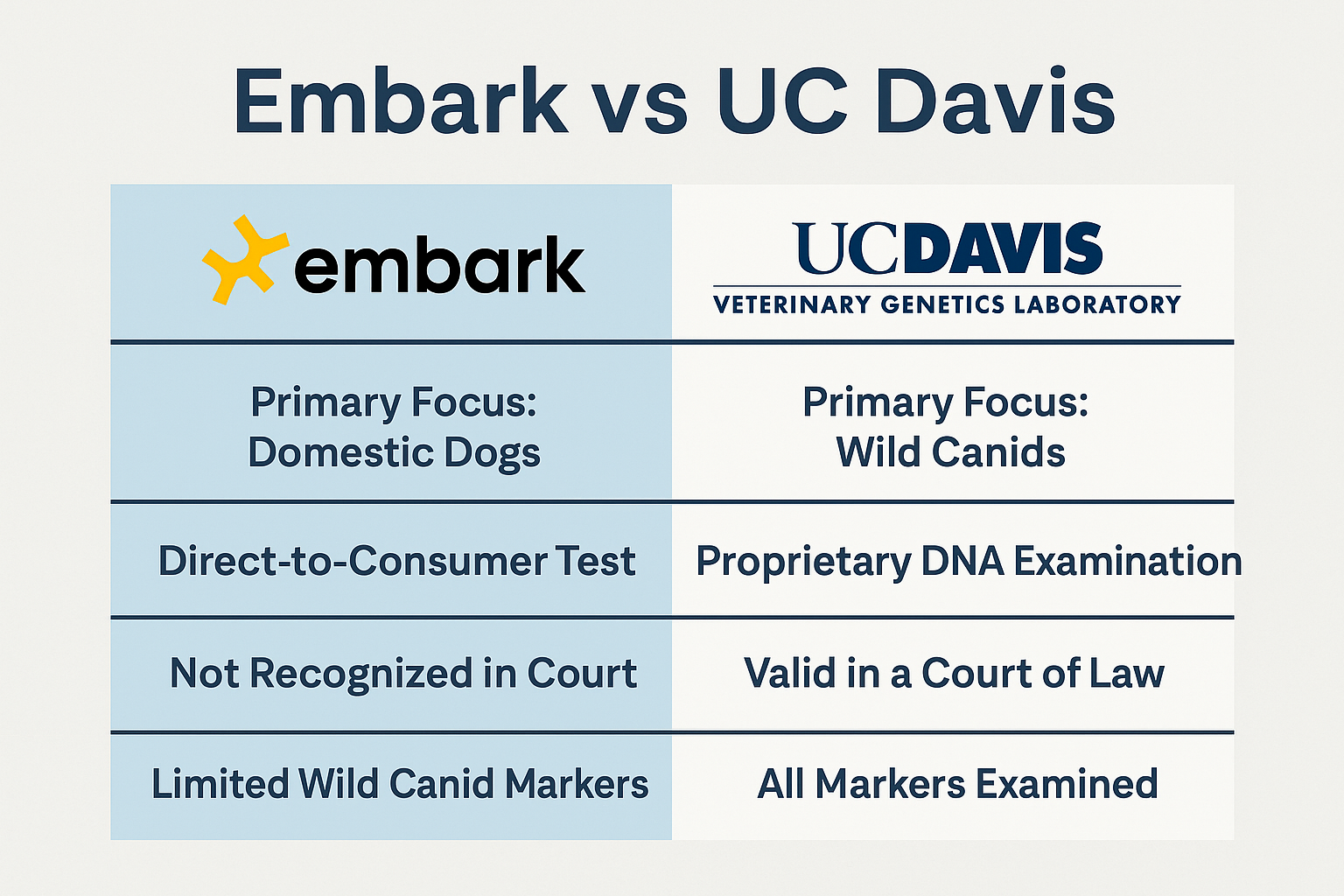
Why UC Davis Is the Gold Standard for Legal Wolfdog Testing
Many people ask: If Embark is backed by Cornell and is considered a leader in consumer DNA testing, why use UC Davis for wolfdog determination?
Here’s the difference:
| Embark | UC Davis |
| Consumer DNA test | Forensic-level DNA examination |
| Focused on breed ancestry | Focused on wild vs domestic origin |
| Interprets large-scale haplotypes | Analyzes marker-by-marker allele patterns |
| Not legally admissible in court | Used in court cases to define wolfdog status |
The UC Davis Veterinary Genetics Lab test is not direct-to-consumer — it is a legal tool used in wildlife cases, wolfdog seizures, and custody disputes. When it comes to whether a dog is a wolfdog or not, UC Davis is the final word.
Some people say the UC Davis test “only goes back three generations.” That’s technically true — because after three generations, wolf traits disappear from the genome in a way that becomes indistinguishable. Both genotypically and phenotypically, the wild-type expressions begin to fade. That’s exactly why even captive-bred high-content wolfdogs lose those extreme traits within just a few generations of being bred to dogs.
In other words: if a wolfdog has been bred down far enough to not trigger UC Davis markers, it is not legally a wolfdog — and that’s what matters in custody, ownership, and local ordinance enforcement.
How the NAIDPP Is Rebuilding the Breed from the Ground Up
Due to decades of breeder mismanagement — high inbreeding, outcrossing to unknown dogs, and no health testing — there is currently no such thing as a genetically “pure” NAID.
The NAID Preservation Project (NAIDPP) was created to change that.
We’re building a new foundation by:
- DNA testing every dog
- Tracking health and COI (inbreeding coefficient)
- Classifying dogs by generational level (F1–F7)
- Breeding for type: sound structure, stable temperament, and working ability
- Partnering with geneticists to eventually restore the breed’s unique DNA signature
Many of our current dogs test in the 30–60% range for known ancestral components. We breed forward with a clear plan, not a false promise of purity. Our goal is to reach full standardization within 5 years.
So, Are NAIDs Wolfdogs or Not?
Let’s be clear:
✅ Some lines of NAIDs do carry ancient wolf ancestry
❌ That does not mean they are recent wolfdog hybrids
❌ That does not make them illegal or dangerous
✅ Embark’s default label is cautious — not definitive
Zach’s own words underscore this complexity:
“Where the gray wolf ancestry is in the genome matters a great deal to the animal’s looks and behavior… As we don’t currently use their genomic positions, the safer bet is to treat any dog with gray wolf ancestry as a wolfdog.”
That’s a general policy, not a comment on your dog.
What Should Owners and Breeders Do With This Info?
If you’re a current or future NAID owner, here’s what to keep in mind:
- DNA tests are powerful tools — but they require interpretation.
- Phenotype matters: What your dog looks like, how they behave, how they bond.
- Preservation work is slow, methodical, and essential. We’re committed to rebuilding the breed the right way.
- Ask your breeder about generational level, phenotype consistency, health testing, and how they interpret DNA results.
Final Thoughts
DNA testing has opened new doors — but it has also brought new misunderstandings. The gray wolf signal in NAIDs is not a secret scandal or proof of deception. It’s a historical echo of the breed’s origins, and part of what makes them so unique.
At Corn Moon Medicine Dogs and through the NAID Preservation Project, we’re committed to transparency, science, and tradition. We’re not just preserving a breed — we’re protecting a legacy.
🧬 FAQ: Key Genetics Terms Explained
Q: What is a genotype?
A: A genotype is the genetic code an animal carries — the actual DNA sequence that determines inherited traits. Think of it as the blueprint hidden inside the dog’s cells.
Q: What is a phenotype?
A: A phenotype is how a dog’s traits actually show up — including their appearance, behavior, and temperament. It’s the result of the genotype plus environment. Two dogs can have similar genotypes but different phenotypes based on how they’re raised or what genes are activated.
Q: What is a haplotype?
A: A haplotype is a group of genes that are inherited together from a single parent. DNA testing companies look at haplotypes to trace ancestry because they help identify patterns shared across breeds or populations.
Q: What does filial mean (F1, F2, etc.)?
A: “Filial” refers to generation. F1 means first generation after an outcross; F2 is the second generation, and so on. When we say a dog is F7, it means they are the seventh generation bred within the same line — a sign of breed consistency.
Q: What is an allele?
A: An allele is a version of a gene. Every dog inherits one allele from each parent for each gene, and these can influence everything from coat color to temperament. Some alleles come from wild ancestors (like gray wolves) and can linger for many generations.
🧬 Want to Learn More?
Check out our related posts:
