If you’ve spent any time around purebred dogs, you’ve heard the word “inbreeding” used like a moral verdict: good breeder / bad breeder.
But genetics doesn’t work like that.
Every established breed on earth exists because humans used related dogs to “set” type, meaning they used related dogs in breed development because they will reliably reproduce the same look, structure, temperament, and working aptitude. The question isn’t whether a breeding program uses relatedness. The real question is:
Is it being used deliberately, temporarily, and transparently, while protecting long-term health?
That’s what this article is: a deep, plain-English guide to COI (Coefficient of Inbreeding), why it exists, what it predicts, how it can harm, and how responsible preservation breeders manage it—especially when developing or stabilizing a young or rebuilding breed.
1. What COI actually means (in human language)
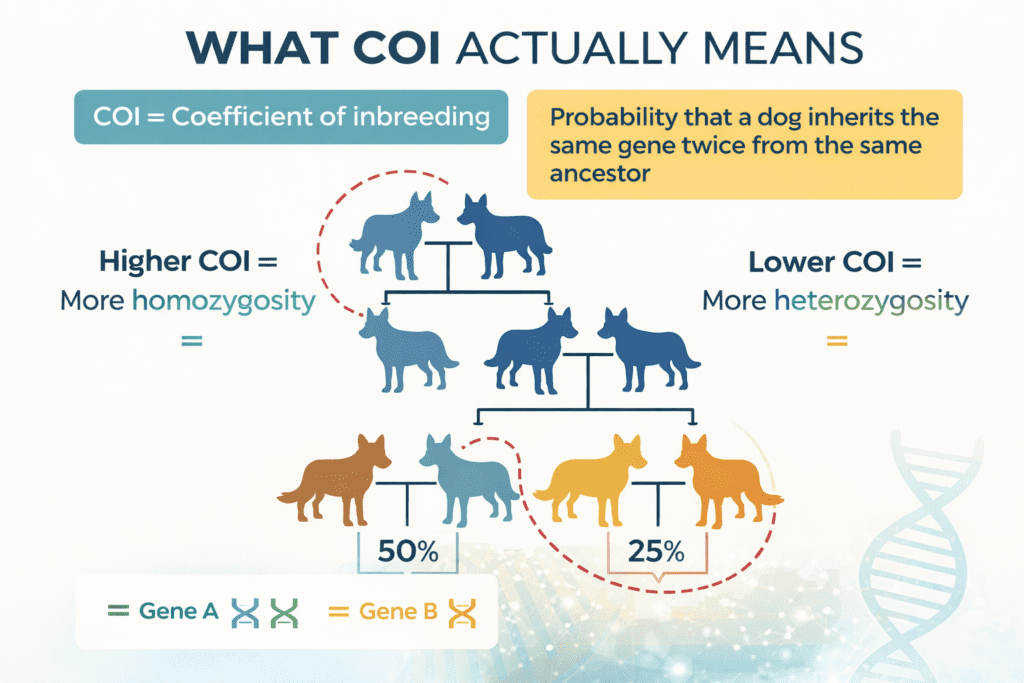
COI = the probability that the two copies of a gene in a dog are identical because they came from the same ancestor.
- A higher COI means more homozygosity (more “same-same”)
- A lower COI means more heterozygosity (more genetic variety).
Important: COI is not an “inbreeding score” per se. COI is a risk dial and a tool that helps predict whether a population is drifting toward problems from reduced genetic diversity.
Pedigree COI vs DNA COI (why people get confused)
There are two common ways COI is estimated:
- Pedigree COI – calculated from known ancestors in a pedigree.
- Only as good as the pedigree depth and accuracy.
- Can underestimate true relatedness if founders are unknown or lines are incomplete.
- Genomic COI – calculated from the dog’s DNA (often via “runs of homozygosity,” ROH).
- Captures what actually happened in the genome.
- Especially useful when pedigrees are incomplete or when a breed is being rebuilt/expanded.
This is why, in modern preservation work, DNA-based COI has become the gold standard for real-world decision making—because it measures the dog, not just the paper.
2. Why inbreeding exists in purebred dogs (and why it’s not automatically “irresponsible”)
To create a recognizable breed, you must make traits predictable across generations. That predictability comes from concentrating the genes that produce the traits you want:
- structure and movement
- coat type and pattern
- size and proportions
- temperament stability
- working instincts and aptitude
The genetic mechanism behind “breeding true” is increased uniformity—and uniformity is created by reducing variation (at least temporarily).
That’s why you’ll hear preservation breeders distinguish between:
- Linebreeding (planned relatedness to set type)
- Close inbreeding (very close relatives, higher risk)
- Outcrossing (adding unrelated genetics to widen diversity)
These aren’t moral categories. They’re tools, and like any tool, they can be used with skill or misused with arrogance.
3. The hard truth: inbreeding has measurable biological costs
When you reduce genetic diversity, you increase the chance that harmful recessive variants show up as actual disease, and you reduce “buffering” diversity that supports resilience.
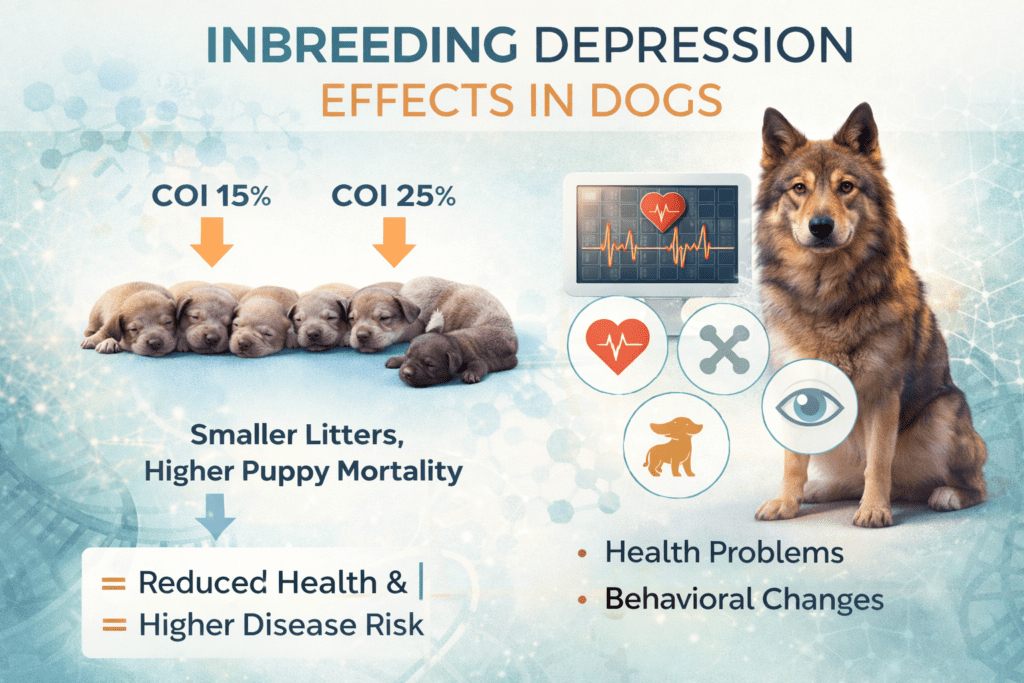
This shows up as inbreeding depression: a collection of negative outcomes tied to reduced heterozygosity.
A few well-documented outcomes
- Smaller litters / reduced fertility
- Higher puppy loss
- Shorter lifespan
- Higher disease burden
- Reduced overall “fitness”
In Golden Retrievers, for example, researchers found that each ~10% increase in genomic inbreeding was associated with about one fewer puppy per litter, on average.
Across multiple breeds, studies also report negative relationships between inbreeding and litter size and early survival.
Large-scale analyses have found inbreeding and body size both contributing to increased morbidity (more veterinary care/health problems across breeds).
And within-breed work in Golden Retrievers found outbred individuals tended to live longer than more inbred individuals.
What about behavior?
Behavior is messy because it’s genetics + epigenetics + early environment + training. But biologically, it makes sense that reduced diversity can correlate with:
- lower stress resilience
- higher reactivity/anxiety tendencies
- reduced adaptability
The clean, honest takeaway is this:
High inbreeding can make “bad luck” more likely and reduce the dog’s margin of resilience.
That’s why preservation breeding demands planning, not vibes.
4. “What COI is acceptable?” The answer depends on your timeline and your mission
This is where the internet loses its mind, because people want a single number. You’ll often hear:
“Keep COI around 15% and you’re fine.”
That’s not a complete statement. It ignores:
- whether the breed is already standardized
- how small the breeding population is
- whether a bottleneck occurred
- how long high COI is being maintained
- whether outcrosses are planned
- whether selection is ruthless about health/temperament
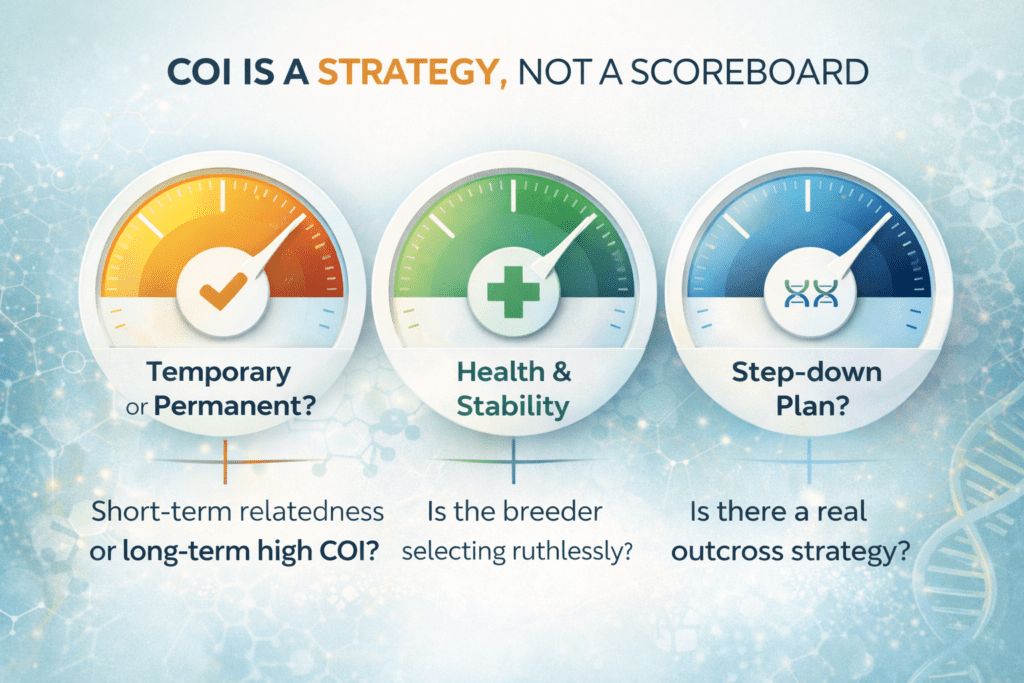
The more accurate framing: COI is a strategy, not a scoreboard
A responsible preservation program thinks in phases:
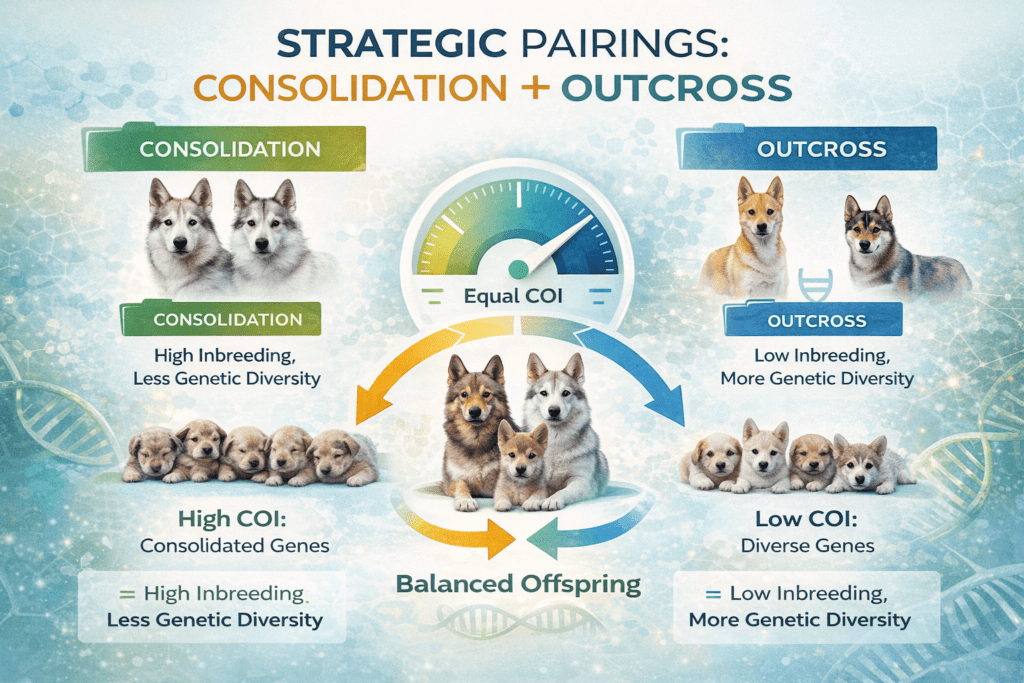
Phase 1: Establishing type (short-term higher relatedness may be used)
If you’re stabilizing a young or rebuilding breed, you may temporarily accept higher COI to lock in consistent type, but only if you have a plan to step it down.
Phase 2: Stabilization (begin reducing COI while protecting type)
Once the dogs reliably reproduce true-to-type traits, the mission shifts:
- maintain type through selection
- lower average relatedness
- expand the effective gene pool
Phase 3: Long-term stewardship (low-to-moderate COI with genetic breadth)
This is where healthy breeds live:
- broad enough diversity for resilience
- controlled enough selection to preserve type
A key concept here is duration. A population might survive short periods of higher COI far better than it can survive decades of it, especially if a “popular sire” effect or repeated bottlenecks keep shrinking the gene pool.
(Translation: the number alone isn’t the full story. The trend matters.)
5. The real enemy isn’t “inbreeding.” It’s unmanaged inbreeding.
Most catastrophic breed decline doesn’t happen because someone linebred once. It happens because of a few predictable failures:
Failure #1: The popular sire effect
A small number of males get used everywhere. That concentrates not just “good traits,” but also hidden harmful variants across the whole breed.
Failure #2: Bottlenecks and closed doors
If a breed has limited founders, limited breeder collaboration, or closed registries with no planned diversity management, COI creeps upward even when breeders think they’re being careful.
Failure #3: Close-relative breedings used as a shortcut
Sibling breedings and parent–offspring breedings can rapidly inflate homozygosity and amplify hidden recessives. In rare situations someone may attempt them for a very specific reason, but it’s high-risk and requires ruthless culling from breeding and deep genetic literacy.
Failure #4: “Outcrossing” done without identity protection
The opposite extreme is also destructive: adding unrelated dogs that look close enough, but don’t carry the true genetic identity and behavioral “type” of the breed.
That creates something that resembles the breed on the outside—but doesn’t reproduce true in temperament, aptitude, or long-term consistency.
6. What relationships are “off-limits” (and what can be managed)
Let’s be blunt. In most preservation programs with a long view:
Generally off-limits (because the risk is high)
- Full sibling × full sibling
- Parent × offspring
Those pairings can be done in animals in tightly controlled scientific or agricultural contexts, but in dogs, where the stakes include lifelong temperament stability and family placement, this is usually a bad gamble.
Sometimes used with caution (context matters)
- Half sibling pairings
- Grandparent × grandchild
- Linebreeding through a shared ancestor on one side only
These can increase predictability without exploding homozygosity the way the closest pairings can, especially when balanced by unrelated genetics on the other side and followed by a step-down strategy.
The principle is an important one and it’s worth stating clearly:
When relatedness is “stacked” on both sides of a pedigree, consolidation accelerates. When it’s present primarily on one side (and the other side is diverse), the risk profile can be very different.
7. “Male outcross vs female outcross”: what’s true, what’s oversold
You’ll hear breeders claim that certain outcross directions are “safer” because genetics “passes differently” from sire vs dam.
Here’s the honest version:
- Most genes are inherited equally from both parents.
- But there are important exceptions:
- Mitochondrial DNA comes from the dam (energy systems).
- Sex chromosomes differ (X/Y), so sex-linked traits can behave differently.
- Maternal effects (uterus environment, early care, epigenetics) can strongly shape outcomes even when DNA is identical.
So yes, direction can matter in real life. But if a program uses directional preferences, the strongest justification usually comes from:
- observed outcomes in that population
- known sex-linked issues
- maternal-line considerations
- the specific traits being protected or corrected
A mature program treats this as population-specific strategy, not internet doctrine.
8. The modern toolkit: how responsible breeders predict and manage COI
This is where preservation stops being guesswork.
Tool A: Genetic COI testing (ROH-based)
Genomic COI gives a direct window into homozygosity. It also helps reveal:
- whether the dog carries lots of long ROH segments (recent inbreeding)
- or lots of shorter ROH segments (older population bottlenecks)
Tool B: Predictive pairing tools
Many databases and registries allow estimated COI predictions for potential matings based on pedigree and/or genomic relationships so you can choose pairings that:
- stay inside a target
- protect type
- reduce risk
Tool C: Health testing + selection pressure
COI management without selection is meaningless. A preservation program needs:
- orthopedic testing (OFA/PennHIP, etc.)
- cardiac/eye screening where relevant
- breed-relevant genetic panels
- temperament and stability evaluation under real life stress
Because COI doesn’t tell you which disease risk is present. It tells you how likely hidden risks are to surface.
9. How we approach this in the NAID Preservation Project: transparency + staged management
We’ve promised radical transparency, so we share COI because we believe the public deserves to understand what ethical breed development actually requires.
Our work sits between two historical failure modes that have damaged the NAID world:
The first failure mode: extreme consolidation
Some lines have been bred into very high inbreeding levels, the kind of numbers that predict trouble: reduced litter vitality, rising structural issues, and unstable temperaments over time.
The second failure mode: identity dilution
Other programs, trying to avoid those risks without access to compatible preservation stock, introduced dogs that fit “the look” but didn’t carry the true NAID genetic identity and behavioral type, creating long-term inconsistency.
So our method is a third path:
- protect the essence of the NAID
- build a standardized, predictable type
- use inbreeding deliberately as a temporary tool
- and then step COI down through strategic outcrossing and careful selection
We’re operating with a long-range breeding plan across associated programs, including planned exchanges of breeding stock and planned outcross windows, because this cannot be done responsibly in isolation.
And we’re being honest about where we are:
- much of our active stock is still in early generations (F1–F3)
- stabilization becomes far more visible once we’re consistently producing F4 and beyond
- as we stabilize, the priority shifts harder toward lowering long-term COI while keeping type
That’s how preservation becomes real stewardship instead of marketing.
10. A simple way to teach COI to the public (the “three dials” model)
When someone sees a COI number, they should immediately ask three questions:
Dial 1: Is this temporary or permanent?
Short-term consolidation can be part of standardization. Long-term high COI is where decline accelerates.
Dial 2: Is the program selecting hard for health + stability?
If selection is weak, COI becomes a multiplier for bad outcomes.
Dial 3: Is there a step-down plan with real outcross strategy?
If the answer is no, the population drifts toward a genetic corner.
This model keeps people from making shallow judgments while still protecting them from real red flags.
FAQ: The questions people are thinking but don’t know how to ask
“So is inbreeding good or bad?”
It’s neither. It’s a tool.
Unmanaged inbreeding is bad. Planned, temporary consolidation with a step-down strategy can be part of ethical breed development.
“Does a low COI guarantee health?”
No. It reduces certain risks, but health also depends on:
- what variants exist in the population
- selection decisions
- environment
- testing and management
“Why do some high-COI lines look ‘beautiful’?”
Because high relatedness can produce visual uniformity fast. The bill often comes later in fertility, immune resilience, orthopedic soundness, and longevity.
Closing: Why we share this (and what we want our community to become)
We’re not sharing COI to win arguments. We’re sharing it because we want to raise the standard of understanding.
If you follow this breed’s journey while learning what it truly takes to steward genetic identity, health, temperament, and type, then you don’t just “own a dog.”
You become part of a preservation story.
And the NAID becomes more than a look. It becomes a lineage protected with intention.
