How Much Does a Native American Indian Dog Cost? (And Why)
By Rebecca Michal · April 16, 2026 · Updated November 2026 · 15 min read
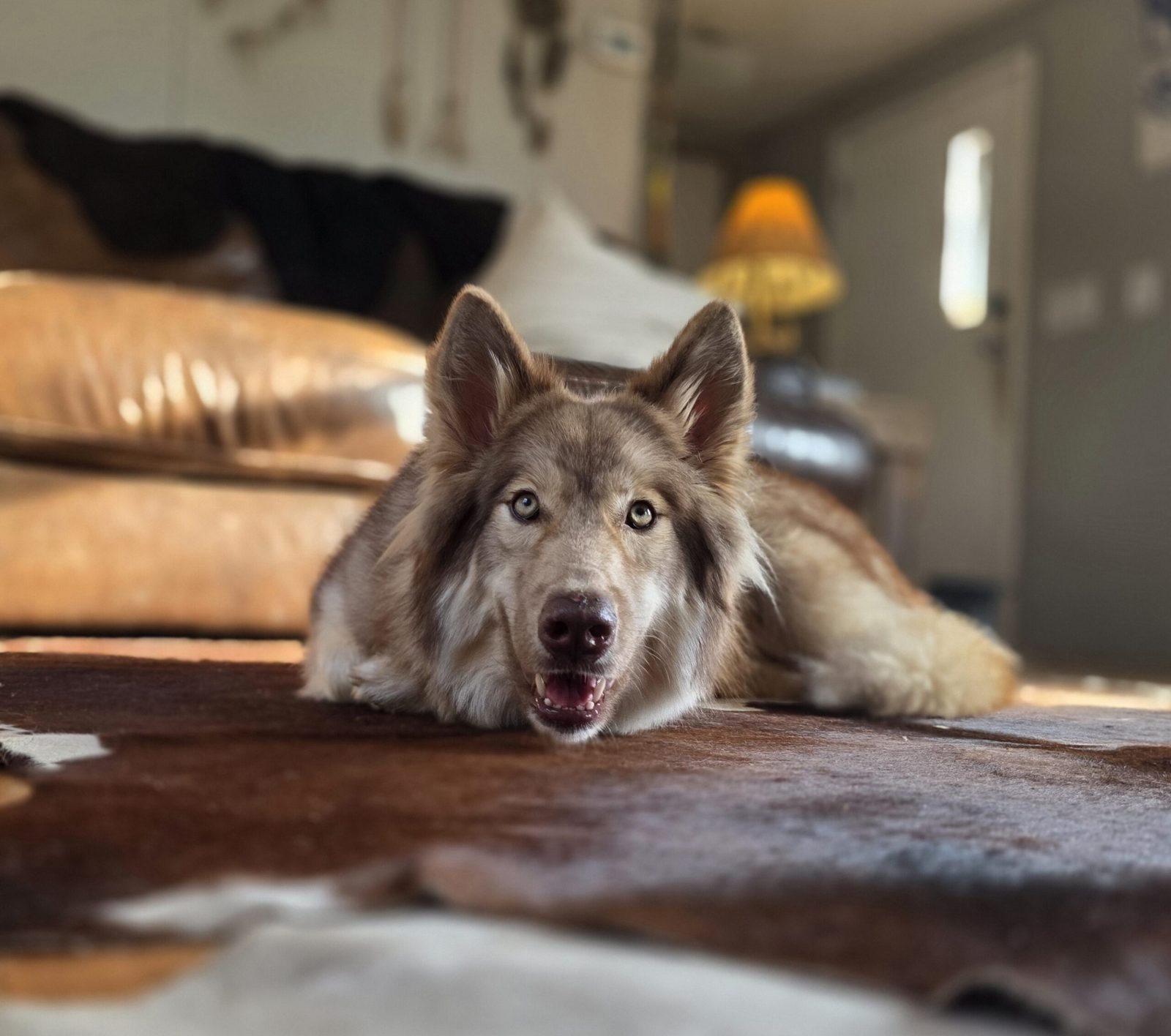
At Corn Moon Medicine Dogs, the current price of a companion puppy is $3,400.
That is our published price. It is not a price for the breed as a whole. Other Native American Indian Dog breeders set their own prices, and those prices reflect their own programs, locations, expenses and placement arrangements. Transportation, optional extended puppy foundations and other elective services are arranged separately where they apply.
A puppy’s price is also only the figure a buyer sees. Behind it sit years of decisions and expenses that never appear on an invoice. So the question I want to answer is a broader one: what actually goes into producing a healthy, well-prepared puppy while also working to preserve a small and still-developing breed population?
The Investment Begins Years Before a Litter
Every Corn Moon litter starts with a dog chosen years earlier. Sometimes she is a puppy we kept from one of our own litters because her temperament, structure or pedigree stood out. Sometimes she is a young dog from another preservation program, brought in to widen the genetic base. Either way, she arrives as a prospect.
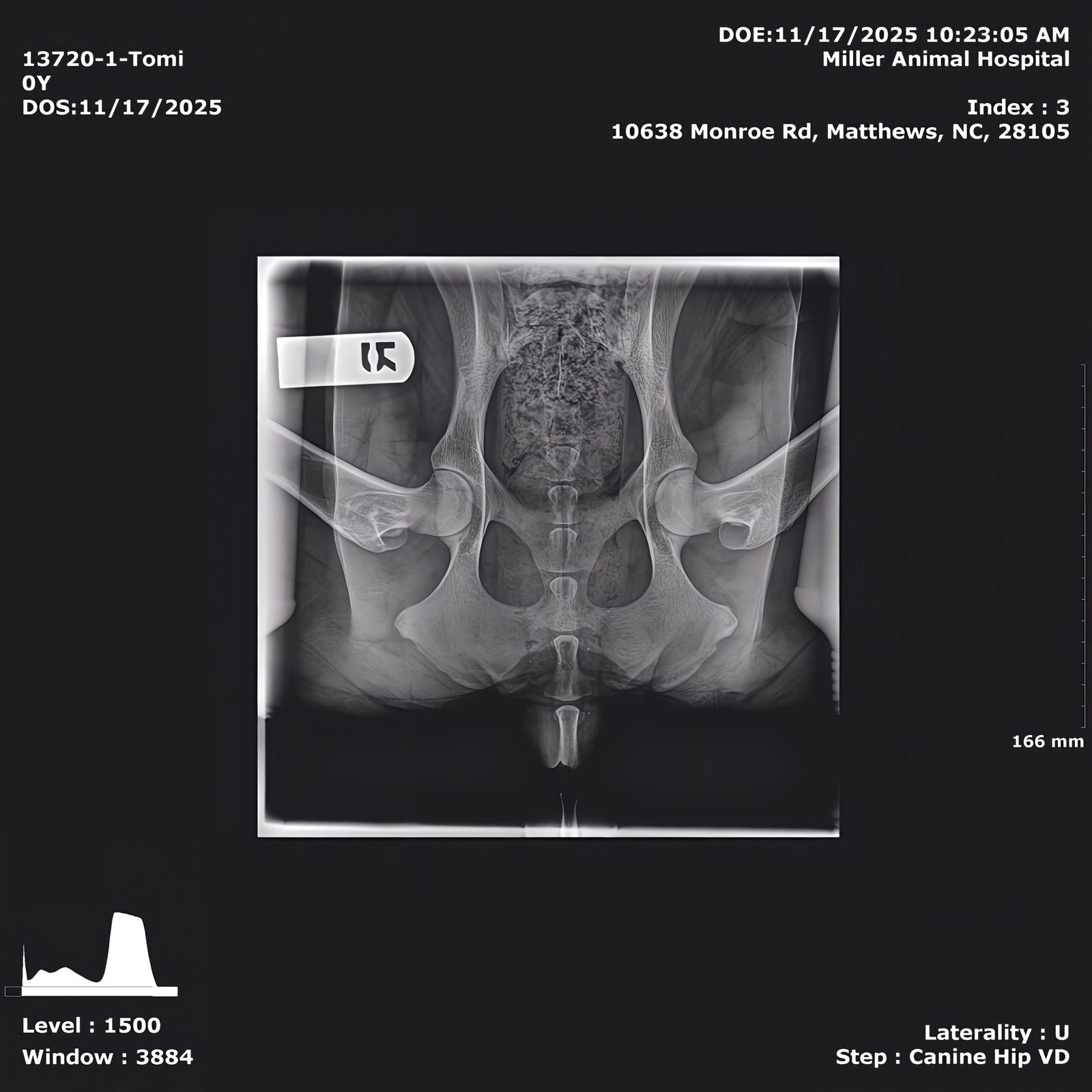
We raise her the way we raise every dog here, with daily care, whole-food nutrition, training, socialization and a full place in our household, and we watch her mature. Some of the qualities we care about most, such as steadiness, recovery after a fright and composure in new places, only become clear with time. Formal health evaluations wait until she is old enough for the results to mean something; final OFA hip ratings, for example, require radiographs taken at 24 months or older.
All that time, a prospect costs as much to keep as any other dog, and she has produced nothing. Not every promising puppy becomes a breeding dog. A dog may be a wonderful companion and still be unsuitable because of a health finding, a temperament concern, a structural fault, or a pedigree that does not fit what the program needs. Her future is then decided around her own welfare, and the years invested in her are absorbed by the program. Responsible breeders carry these costs without receiving a litter in return.
What Health Testing Can and Cannot Tell Us
Families sometimes picture a single test that declares a dog healthy. In practice, health testing is a collection of separate evaluations, each answering a narrow question, and the real work lies in reading them together.
Evaluating the Dog Itself
Several of the evaluations we use in breeding decisions look at the dog’s actual body, what geneticists call the phenotype. Hips are evaluated through PennHIP, which measures how loose the hip joint can be, and through OFA, which grades how the joint looks on a standard radiograph. The Preservation Project has adopted PennHIP as its preferred hip screening method, for reasons explained in our PennHIP article. Elbows are radiographed as well. Eyes are examined by a board-certified veterinary ophthalmologist through the Companion Animal Eye Registry (CAER), and thyroid function is screened through blood work. Temperament is assessed through structured evaluation and long observation, and every result is read alongside the dog’s pedigree and family history.
Each involves veterinary visits, specialist fees, sedation for some radiographs, travel and registry submissions, and eye and thyroid screening is repeated because results can change with age.
What a DNA Panel Shows
Genetic screening is a different kind of information. A DNA panel looks for specific known variants linked to inherited diseases and reports whether a dog is clear, a carrier, or at risk. We use it, and it is valuable. A clear panel means only that the dog does not carry the variants that panel tests for. It cannot rule out conditions with no known test.
Hip dysplasia is a good example. It is a complex, multifactorial condition shaped by many genes together with growth, nutrition, body weight and exercise, and published heritability estimates vary widely between studies. There is no single gene to test for, so breeders rely on imaging of the dog and its relatives and on records gathered across generations.
Reading Results in Context
Health testing tells us about risk. It cannot guarantee anything about future puppies. Two parents with excellent results can produce a puppy with a problem, and a dog with a less-than-ideal result may still have a sound place in a careful breeding plan.
So we read each finding in the context of the dog, its parents, siblings and offspring, the proposed mate and the wider population. A very large breed can afford to exclude every dog with an imperfect score. In a small population, excluding too many dogs narrows the gene pool and creates new problems. Responsible breeding sometimes means weighing one genetic risk against another, choosing a pairing that should improve the next generation, and following the outcomes closely. Families deserve to hear exactly what we know, including its limits. Our article on health and genetic responsibility explains all of this in much greater depth.
Preservation Breeding Carries Responsibilities Beyond the Litter
The Native American Indian Dog is an uncommon breed with a developing preservation framework and a comparatively small breeding population. In a breed like this, every litter affects the future of the population, so a breeder has to think in generations.
Pedigrees are documented and, where possible, ancestry is checked through DNA, as described on our Registry & DNA Records page. We track relatedness between potential mates and calculate inbreeding coefficients, because a small population loses diversity quickly when the same few dogs appear again and again. A popular sire used too often can create a bottleneck that later breeders cannot undo. Managing Inbreeding in Dogs explains how the coefficient of inbreeding works as a tool. Protecting diversity sometimes calls for a carefully planned outcross, a dog from a different line chosen after studying its pedigree, health and temperament, and the value of that decision may not be clear for several generations.
A preservation breeder is also working to keep the temperament, structure and character described in the Official NAIDPP Breed Standard, with the documented history of the breed as context. We study health patterns across generations and keep records so that future breeders can see what worked and what did not. Much of this work brings no immediate return. Its value will show in dogs who have not yet been born.
Corn Moon and the Preservation Project
Corn Moon Medicine Dogs is a breeding program. The Native American Indian Dog Preservation Project (NAIDPP) is a separate 501(c)(3) nonprofit organization dedicated to the long-term documentation, stewardship and development of the breed, and its public Breeder Standards describe what participating programs commit to. Corn Moon is the Project’s founding program and takes an active part in its preservation work, but the two are distinct organizations. A Corn Moon puppy is purchased from Corn Moon. The purchase price is not a donation to the Project, and it is not tax-deductible.
Pregnancy, Whelping and the First Weeks
Producing a litter is less predictable than most people imagine. Breeding has to be timed to the female’s cycle, sometimes with progesterone testing or other reproductive evaluations when they are indicated. If the chosen male lives with another program, there is travel and coordination, often on short notice. Not every mating results in a pregnancy, and when one does not, the cost of that attempt is spent.
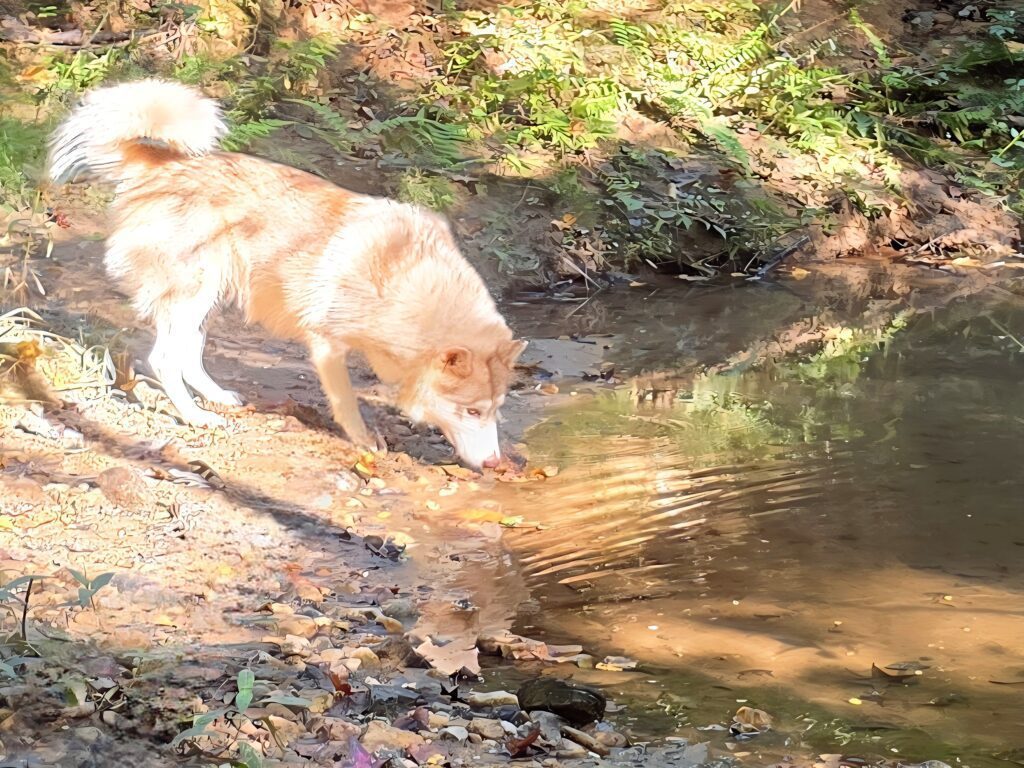 A pregnant Corn Moon dam at the creek. Her nutrition and condition are followed closely through every stage of pregnancy.
A pregnant dam’s diet is adjusted as her pregnancy advances, and she is monitored closely. Before she is due, a clean, warm and safe whelping area is prepared in our home. Labor and delivery are watched around the clock, because problems can develop quickly; some deliveries need a veterinarian, and occasionally a dam needs emergency surgery. After the birth, puppies are weighed and checked regularly and their progress is recorded, while the dam’s appetite, milk, temperature and recovery are watched just as closely.
Even with excellent care, not every pregnancy produces a healthy litter, and puppies are sometimes lost. Every litter is different, and the care each one needs changes with the dam and her history, which is why breeders keep reserves for the unexpected.
Raising Puppies Is Developmental Work
Corn Moon puppies are born and raised in our home, and their weeks with us follow a developmental plan described in detail on our Puppy Program page.
Early Neurological Stimulation
During roughly the third through sixteenth days of life, each puppy takes part in Early Neurological Stimulation (ENS), a short series of gentle exercises, such as holding the puppy in a few positions and lightly touching between its toes, done once a day for a few seconds each. The aim is mild, controlled stimulation while the nervous system develops rapidly. Studies of early handling have reported some differences in later stress responses, but the research is limited, and none of it shows that ENS guarantees a calmer or healthier adult. It is gentle, and it gives us an early, individual look at every puppy.
Early Scent Introduction
Early Scent Introduction (ESI) happens in the same window. Each day, a puppy is offered one new scent, often from the land around our home, and its reaction is noted. Breeders use ESI hoping to encourage curiosity and comfort with scent. Its developmental effects have not been conclusively established, so we treat it as another way of watching each puppy meet something new.
Puppy Culture, Socialization and Habituation
As the puppies grow, our approach draws on Puppy Culture, a structured program that pairs age-appropriate learning with confidence-building, enrichment and steady human interaction. New surfaces, sounds and objects arrive in small steps, along with handling, grooming, household activity, time outdoors and, later, individual outings away from littermates. Veterinary behavior specialists recognize the first months of life as a sensitive period for socialization, and we try to use that time well without overwhelming the puppies.
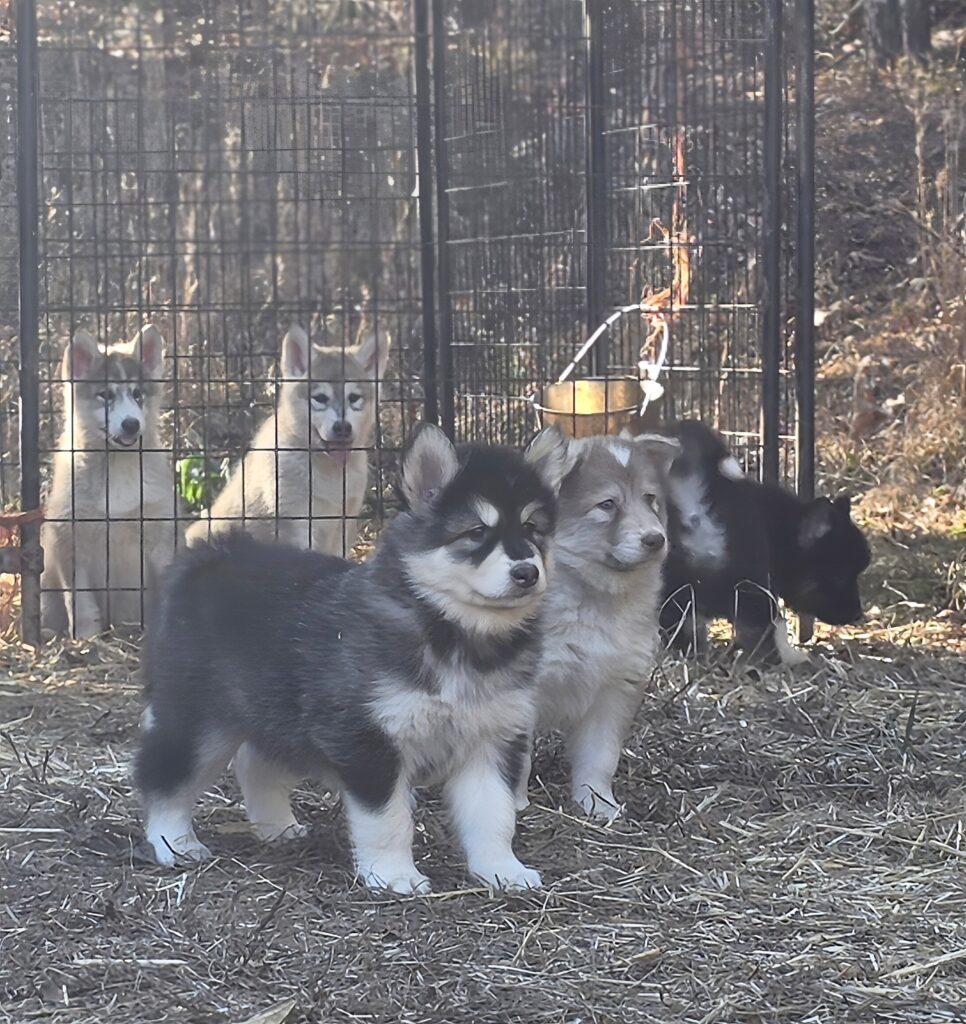 A Corn Moon litter exploring outdoors. New spaces, surfaces and sounds are introduced gradually, as each litter is ready.
Temperament Evaluation and Placement
Once the puppies reach about seven weeks of age, each one goes through a modified puppy aptitude assessment. It is useful, and it captures a single day in a young puppy’s life. Research on personality consistency has found that traits measured in young puppies predict adult behavior less reliably than traits measured later, so we weigh the assessment against everything we have seen since birth.
All of that comes together in placement. We compare what we know about each puppy with each family’s circumstances, experience and expectations. Families take part in that conversation, and we recommend the placement we believe suits each puppy best. The work takes daily observation, planning, supplies and many hours of hands-on time, and none of it guarantees a particular adult temperament or level of health. It gives each puppy a thoughtful start and gives us the knowledge to place them well.
Nutrition, Natural Rearing and Preventive Care
Our dogs and puppies eat a whole-food diet built around raw meat, organ and bone, with supplementation when needed. This is a deliberate program philosophy and one of our larger ongoing expenses. Ingredients have to be raised, hunted or sourced in quantity, stored frozen, handled with care, and balanced for growing puppies, active adults and pregnant or nursing dams.
Part of how we feed our dogs involves producing much of their food on our own family homestead. We keep a small dairy goat herd, and it is our only source of the raw goat milk used in our puppy feeding and weaning protocols. We grow 100% of the pumpkin used in puppy feeding and weaning as well. We also raise turkeys, rabbits, chickens and quail, and these make up a large portion of our dogs’ and puppies’ diets. Beyond that, we do a fair amount of hunting and foraging, and wild game from that work is a regular part of what the dogs eat. We keep our own apiary too, and honey and bee pollen are a regular part of our dogs’ health routine. Producing food this way takes serious dedication, and it is a substantial investment in land, livestock, feed, housing, equipment and time.
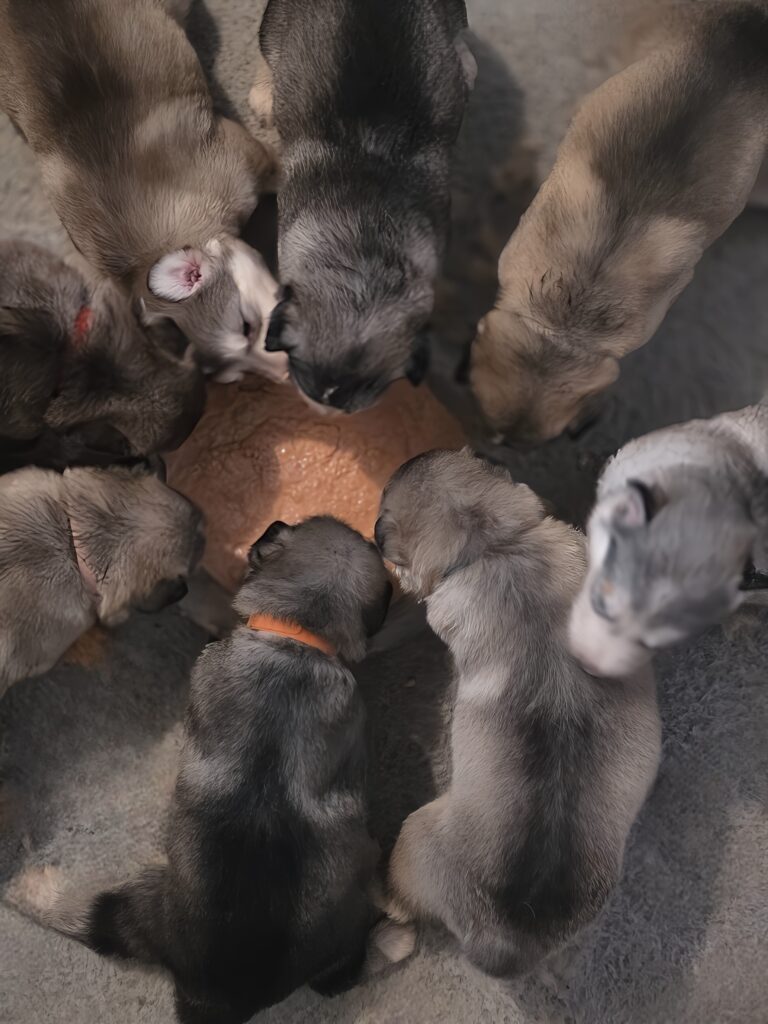 Weaning onto whole food. Every meal for a litter is prepared, portioned and cleaned up by hand.
I feed this way because of what I have seen in our dogs over many years, and research supports it. Research has shown a whole-food diet to be superior to kibble and other processed commercial diets. Studies from the University of Helsinki found that puppies fed raw whole foods early in life were less likely to show allergy and atopy skin signs, and less likely to show inflammatory bowel disease symptoms, as adults. Feeding trials have also found raw and lightly cooked diets more digestible than extruded kibble.
The real risk in whole-food feeding is improper formulation. A diet that is poorly designed can leave a dog short of some nutrients and overloaded with others, and growing puppies of larger breeds are especially sensitive to that kind of imbalance. A proper balance of meat, organs and bone is critical to nutritional balance. Rotating proteins is part of balancing a diet properly, because each animal brings its own mix of amino acids, fats, vitamins and minerals. Careful formulation is part of the daily work for that reason.
Preventive veterinary care is individualized. Puppies receive our initial vaccination protocol, and antibody titers guide later decisions about boosters, with veterinary input and within rabies law. Our practices include the use of homeopathic nosodes as an important part of supporting a puppy through the immune system development stage.
Many people don’t realize that while a puppy’s immune system is still developing and maternal antibodies are still present in its system, vaccinating during that time is often ineffective because of those antibodies. Waiting for the immune system to grow and develop has been shown to be highly beneficial. The studies done by the most renowned veterinary immunologists, Dr. W. Jean Dodds and Dr. Ronald Schultz, have shown that vaccinating a puppy before the age of about 9 weeks is often ineffective, and that the risks can outweigh the benefits. We utilize nosodes to help support our puppies’ developing immune systems until they reach the age where a vaccine makes more sense and is more likely to be effective. We do not claim that nosodes are a replacement for vaccination. We encourage our families to learn about why we utilize nosodes, and about the benefit of this approach to raising a puppy with a healthy immune system. The Natural Rearing page explains our philosophy and protocols in full.
The Expenses Most People Never See
Some costs cannot be assigned to any one puppy, and they continue whether or not there is a litter that year. The property, fencing, living areas and sanitation have to be maintained, and whelping equipment wears out. We keep reserves for veterinary emergencies, because emergency surgery will not wait for a convenient month. There is transportation to veterinary and specialist appointments, the recordkeeping and administration that documentation requires, continuing education, and health monitoring that follows our dogs throughout their lives.
Some of the largest costs involve dogs who will not produce another litter. Retired breeding dogs deserve the same care they received during their breeding years. Sometimes a puppy stays with us longer than planned while the right home is found, and prospects who are never used for breeding still needed years of care before that decision could be made.
The Difference Between Revenue and Profit
People sometimes multiply a puppy’s price by the size of a litter and assume the result is what a breeder earns. That figure is gross revenue, the amount received before a single expense is counted. Here is a simple illustration. If a litter of five puppies sold for $3,400 each, the gross revenue would be $17,000. This is a hypothetical example. It does not describe Corn Moon’s income or profit, and it does not predict litter size. Litters vary, and some breedings produce no puppies at all.
Before anyone could say what that litter returned, the expenses behind it would have to come out: years of care for the parents and for prospects who were never bred, unsuccessful breeding attempts, health testing, veterinary care, feeding, facilities, equipment and a great deal of skilled labor. Many of those costs belong to the program as a whole and are spread across every litter it produces.
Some breeding programs are profitable. Others run on thin margins or lose money in a given year. Financial responsibility and ethical breeding can go together, and a program that cannot sustain itself cannot care for its dogs for long. A puppy’s price, taken alone, tells you very little about the economics behind it. Our priority at Corn Moon is a sustainable program whose breeding decisions serve our long-term preservation goals.
The Lifetime Cost of Owning a NAID
The purchase price is paid once. The cost of caring for a dog continues for its whole life. The breed has historically been reported to live roughly 14 to 17 years, an observed expectation and never a promise, and families should plan for the full span.
A NAID is a sizeable, intelligent and active dog, as our Breed Guide describes. An appropriate whole-food diet for a dog this size is a meaningful monthly expense. Veterinary care continues every year, and an emergency fund matters. Training, enrichment and time outdoors are real needs for this breed, and grooming tools for a double coat, sturdy equipment and secure fencing or containment are part of the setup. Travel and boarding add up over the years, and needs change as a dog ages.
I cannot give a reliable lifetime figure, because costs vary so much by region and household. The real question for any family is whether they can provide good care across a dog’s whole life. Affording the purchase price is only the first step.
How to Evaluate a Breeder Beyond Price
Price on its own is a poor measure of a breeder. A high price does not prove quality, and a lower price does not prove poor practices; many careful breeders charge less than we do. The most useful information comes from conversation, and these questions are a good place to begin:
- What health evaluations have the parents had, and can I see the results?
- What hereditary conditions are known in the family, and how have you responded to them?
- What are your goals for this pairing and for your program?
- How are the puppies raised, evaluated and matched with homes?
- What does your contract say, and what does the health guarantee cover and exclude?
- What support do you offer after a puppy goes home?
- How would you handle a health or behavioral problem that appears later?
- What happens to your breeding dogs when they retire?
- What do the pedigrees look like, and how do you protect genetic diversity?
Listen to how a breeder answers. Transparency, sound reasoning and a willingness to talk openly about limitations are usually the most reliable signs of a careful program.
What a Corn Moon Puppy’s Price Supports
When a family pays $3,400 for a Corn Moon puppy, that money goes back into the work described here: health evaluation, carefully considered breeding decisions, the daily developmental care of each litter, individual placement, and our part in the long-term stewardship of the breed. It does not buy a guarantee of perfect health, a particular temperament or a long life. No breeder can honestly sell those things. Our families receive a puppy whose background we know well and can explain, along with our continued support as that puppy grows up.
When I make decisions for this program, I think about the dogs in our care now, the families who will raise our puppies, and the generations that may follow. Our price is set with all of them in mind.
If this way of breeding makes sense to you, you are welcome to read more about our Puppy Program, see our current and planned litters, or begin with an application.
An application is followed by a phone interview. Corn Moon accepts the $300 reservation deposit only after we have mutually agreed on placement. Only a paid reservation deposit secures your place on the waiting list, under the applicable agreement, and it does not guarantee a specific puppy; an inquiry or application alone does not reserve a place. Read our placement process.
Sources and Further Reading
The sources below support the general statements in this article about screening, inheritance, early development, nutrition and puppy immunity. Corn Moon’s feeding philosophy, developmental routines and placement practices are our program’s own choices, shaped by my experience as a breeder.
Health Screening
- Hip Screening Procedures, Elbow Dysplasia, Eye Certification and CAER and Thyroid. Orthopedic Foundation for Animals.
- What Is PennHIP? Antech Imaging Services.
- How do I interpret my dog’s health results? Embark Veterinary.
Hip Dysplasia and Inheritance
- King MD. Etiopathogenesis of canine hip dysplasia, prevalence, and genetics. Veterinary Clinics of North America: Small Animal Practice. 2017;47(4):753–767.
- Ginja M, Gaspar AR, Ginja C. Emerging insights into the genetic basis of canine hip dysplasia. Veterinary Medicine: Research and Reports. 2015;6:193–202.
Population Genetics
- Leroy G. Genetic diversity, inbreeding and breeding practices in dogs: results from pedigree analyses. The Veterinary Journal. 2011;189(2):177–182.
- Calboli FCF, Sampson J, Fretwell N, Balding DJ. Population structure and inbreeding from pedigree analysis of purebred dogs. Genetics. 2008;179(1):593–601.
Early Development and Temperament
- Battaglia CL. Periods of early development and the effects of stimulation and social experiences in the canine. Journal of Veterinary Behavior. 2009;4(5):203–210.
- Gazzano A, Mariti C, Notari L, Sighieri C, McBride EA. Effects of early gentling and early environment on emotional development of puppies. Applied Animal Behaviour Science. 2008;110(3–4):294–304.
- Position Statement on Puppy Socialization. American Veterinary Society of Animal Behavior.
- Fratkin JL, Sinn DL, Patall EA, Gosling SD. Personality consistency in dogs: a meta-analysis. PLoS ONE. 2013;8(1):e54907.
Nutrition
- Hemida MBM, Salin S, Vuori KA, Moore R, Anturaniemi J, Rosendahl S, Barrouin-Melo SM, Hielm-Björkman A. Puppyhood diet as a factor in the development of owner-reported allergy/atopy skin signs in adult dogs in Finland. Journal of Veterinary Internal Medicine. 2021;35(5):2374–2383.
- Hemida M, Vuori KA, Moore R, Anturaniemi J, Hielm-Björkman A. Early life modifiable exposures and their association with owner reported inflammatory bowel disease symptoms in adult dogs. Frontiers in Veterinary Science. 2021;8:552350.
- Algya KM, Cross TWL, Leuck KN, Kastner ME, Baba T, Lye L, de Godoy MRC, Swanson KS. Apparent total-tract macronutrient digestibility, serum chemistry, urinalysis, and fecal characteristics, metabolites and microbiota of adult dogs fed extruded, mildly cooked, and raw diets. Journal of Animal Science. 2018;96(9):3670–3683.
- Global Nutrition Guidelines. World Small Animal Veterinary Association.
- Lauten SD. Nutritional risks to large-breed dogs: from weaning to the geriatric years. Veterinary Clinics of North America: Small Animal Practice. 2006;36(6):1345–1359.
Puppy Immunity and Vaccination
- Schultz RD, Thiel B, Mukhtar E, Sharp P, Larson LJ. Age and long-term protective immunity in dogs and cats. Journal of Comparative Pathology. 2010;142(Suppl 1):S102–S108.
- Dodds WJ. Vaccination protocols for dogs predisposed to vaccine reactions. Journal of the American Animal Hospital Association. 2001;37(3):211–214.